SaaS & Product Development: From Idea to Scalable Digital Platform
- By, Admin
- 04 Aug, 2021
Software-as-a-Service has transformed how digital products are created, delivered, and scaled. Yet successful SaaS development involves much more than software engineering. It requires market validation, product strategy, strong user experience, secure architecture, sustainable pricing, continuous operation, and disciplined growth.
What This Guide Covers
Software-as-a-Service has transformed how businesses create, deliver, and scale digital products. Instead of installing software on individual devices, users can access SaaS platforms through the web or mobile applications, usually through a subscription, usage-based, or tiered service model.
This approach allows product owners to deliver updates continuously, support users across different locations, collect usage data, and create recurring revenue. It also provides customers with faster onboarding, automatic improvements, and access from multiple devices without complex installation.
However, successful SaaS development involves much more than writing code. It requires a clear product strategy, a validated market need, a strong user experience, secure technical architecture, reliable operations, and a continuous process of learning and improvement. For companies building digital ventures, SaaS and product development provide a scalable path from an initial idea to a commercially viable platform.
What Is SaaS Product Development?
SaaS product development is the process of planning, designing, building, launching, operating, and improving a cloud-based software platform. A SaaS product is usually hosted online and made available to users through recurring subscriptions, usage-based payments, freemium access, or tiered service plans.
Common examples include project-management platforms, marketing tools, customer-management systems, analytics dashboards, content-generation platforms, digital identity solutions, collaboration applications, and workflow systems.
Unlike traditional software projects, SaaS platforms are continuously operated and updated. Development does not end when the platform launches. The product must evolve based on user behavior, customer feedback, market conditions, technical performance, security requirements, and long-term business objectives.
A SaaS product is not simply software delivered online. It is an operating business system that connects technology, customer experience, revenue, data, support, and continuous product improvement.
Why Businesses Choose SaaS
SaaS platforms offer several advantages for both businesses and users. They can be accessed from multiple devices, updated without requiring manual installation, and expanded as the number of users, transactions, or locations grows.
Users can begin through a browser or app without complex local installation.
Features and security improvements can be delivered centrally.
Infrastructure and plans can grow with customer demand.
Subscriptions create more predictable and measurable commercial models.
For users, SaaS platforms often provide lower entry costs, faster onboarding, automatic updates, access to continuously improving features, and the ability to work from different locations or devices.
For product owners, SaaS creates opportunities to build long-term customer relationships, monitor product usage, introduce new plans, develop add-on services, improve retention, and build predictable recurring revenue.
The Importance of Product Strategy
Every successful SaaS product begins with a clearly defined problem. Before development starts, businesses should understand the target user, the problem being solved, the alternatives already available, the essential first-release features, the revenue model, and the expected path to growth.
Without a clear product strategy, teams may spend significant time and resources building features that customers do not need. A strong strategy connects customer needs, commercial objectives, technology decisions, and the long-term product roadmap.
From Idea Validation to Product Launch
The SaaS development process should begin with validation rather than immediate full-scale development. Validation reduces risk by testing whether the opportunity is meaningful before large budgets and long development cycles are committed.
Idea validation may include market research, competitor analysis, customer interviews, concept testing, landing-page experiments, waiting lists, clickable prototypes, and early product demonstrations.
The Role of the MVP
Once the opportunity is validated, the team can define a Minimum Viable Product, commonly called an MVP. The MVP includes the core features required to solve the main customer problem and test the product in the real market.
The purpose of an MVP is not to launch an incomplete or low-quality platform. It is to create a focused, reliable version of the product that can be tested, improved, and expanded using real customer feedback and measurable usage data.
Confirm the problem, customer group, urgency, alternatives, and willingness to adopt or pay.
Develop only the features required to deliver the main value proposition reliably.
Use feedback, behavior, and commercial performance to guide the next product decisions.
User Experience and Interface Design
A technically powerful product can still fail if users find it difficult to understand or use. User-experience design should make the platform clear, efficient, and consistent. Navigation, onboarding, dashboards, forms, notifications, and account settings should help users complete tasks with minimal effort.
Good product design considers the entire customer journey, not only individual screens.
The interface should also work effectively across desktop computers, tablets, and mobile devices. Responsive behavior, readable typography, clear feedback, accessibility, and predictable interactions all contribute to product trust and adoption.
Building a Scalable Technical Foundation
The technical architecture of a SaaS product should support current needs while allowing the platform to grow. Scalability does not mean building an unnecessarily complex system from the beginning. It means making thoughtful technical decisions that allow the product to handle more users, features, transactions, integrations, and markets over time.
Security and Data Protection
SaaS platforms frequently store user profiles, business information, payment records, documents, messages, analytics, and other valuable data. Security should therefore be considered from the earliest stages of product design and development.
Common security requirements include encrypted connections, secure password storage, role-based permissions, access controls, activity monitoring, vulnerability testing, incident response procedures, and reliable backup systems.
Businesses should also consider the privacy and data-protection laws that apply in their target markets. Clear privacy policies, transparent data practices, appropriate data-retention rules, and secure third-party integrations are essential for building customer trust.
Subscription and Revenue Models
One of the strongest advantages of SaaS is the ability to create recurring revenue. The pricing model should reflect the value users receive rather than only the technical cost of operating the platform.
Businesses should also consider customer-acquisition costs, operating expenses, infrastructure, payment-processing fees, support requirements, gross margin, retention, and expected customer lifetime value when developing their pricing strategy.
Launching and Improving the Product
A SaaS launch should be treated as the beginning of the product lifecycle, not the end of development. Once real users begin using the platform, teams gain access to evidence that cannot be fully reproduced during internal testing.
These insights help teams understand what is working, where users face difficulties, and which improvements should be prioritized.
Successful SaaS companies continuously release updates, improve performance, refine the user experience, enhance security, strengthen support, and introduce new capabilities based on evidence rather than assumptions.
The Role of Artificial Intelligence
Artificial intelligence is increasingly becoming part of SaaS product development. AI can support content creation, customer service, recommendations, analytics, automation, personalization, document processing, forecasting, and decision-making.
However, AI should be introduced when it creates meaningful value for the user. Adding artificial intelligence without a clear purpose can increase cost, complexity, risk, and user confusion without improving the product.
The strongest AI-powered SaaS products combine intelligent automation with practical workflows, clear controls, reliable data, measurable outputs, privacy safeguards, and appropriate human oversight.
Building Products for Long-Term Growth
Sustainable SaaS development requires alignment between strategy, design, technology, operations, customer success, marketing, and growth. The product must solve a real problem, deliver a reliable experience, support a clear revenue model, and adapt as customer needs change.
Long-term growth also depends on operational discipline. Teams need product roadmaps, release processes, support procedures, performance monitoring, security reviews, financial planning, retention programs, and a clear method for prioritizing customer feedback.
Companies that treat SaaS as a continuously operated digital venture are better positioned to build stronger products, deeper customer relationships, recurring revenue, and long-term enterprise value.
What Businesses Should Remember
SaaS & Product Development FAQ
What is the difference between SaaS development and traditional software development?
Traditional software may be delivered as a completed installation, while SaaS is continuously hosted, operated, monitored, updated, and improved as an ongoing digital service.
How long does it take to build a SaaS MVP?
The timeline depends on scope, integrations, complexity, security, and team capacity. A focused MVP is usually faster to validate and improve than a large first release.
Does an MVP mean a low-quality product?
No. A strong MVP is limited in scope but reliable in execution. It solves the core problem effectively while postponing nonessential features.
What are the most important SaaS metrics?
Important metrics may include activation, engagement, conversion, recurring revenue, retention, churn, customer-acquisition cost, lifetime value, support volume, and technical performance.
When should artificial intelligence be added to a SaaS product?
AI should be introduced when it improves a real workflow, reduces effort, increases accuracy, enables personalization, or creates measurable value for users.
Can SaaS products support international markets?
Yes, but international growth may require multilingual interfaces, regional payment options, legal compliance, local support, data-location planning, and market-specific onboarding.
From Market Opportunity to Scalable Digital Venture
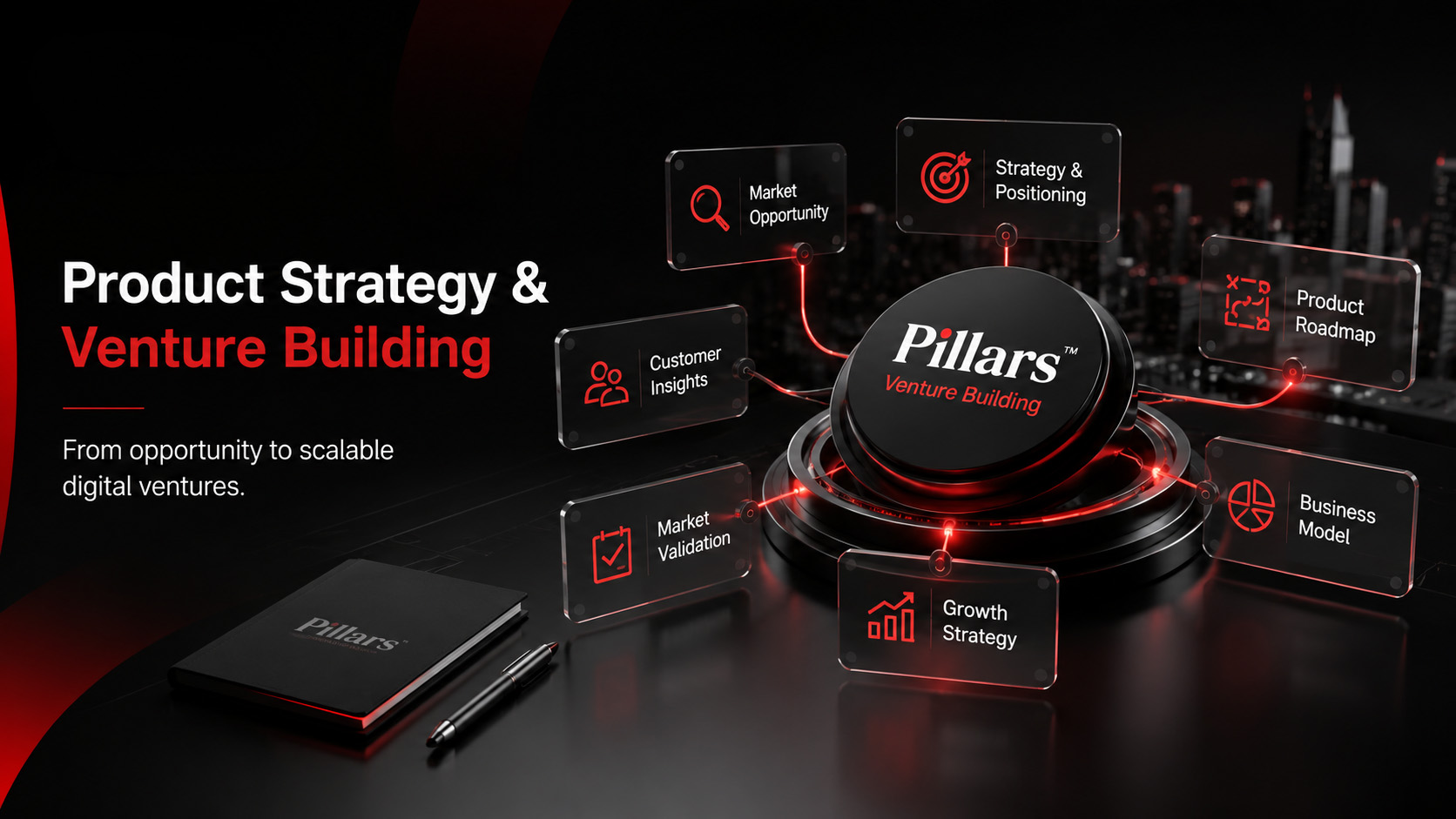
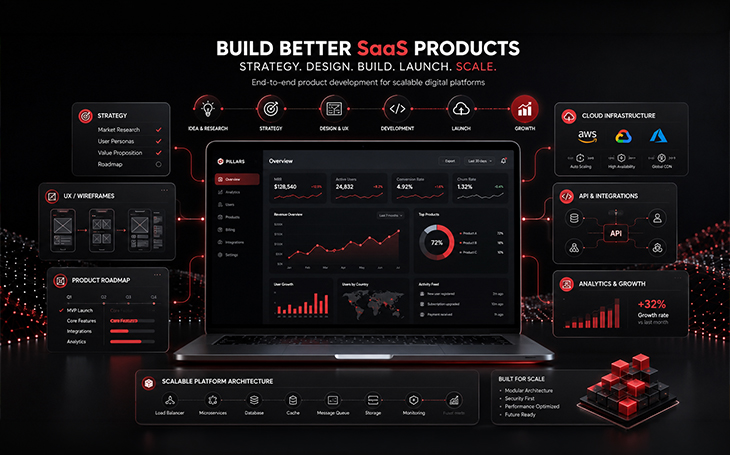
At Pillars, SaaS and product development are approached as an end-to-end process that connects market opportunity, product strategy, validation, platform design, technical development, artificial intelligence, cloud infrastructure, launch preparation, continuous operation, and scalable growth.
Pillars combines strategy, product design, software development, AI, cloud operations, and growth expertise within one integrated venture-building model.